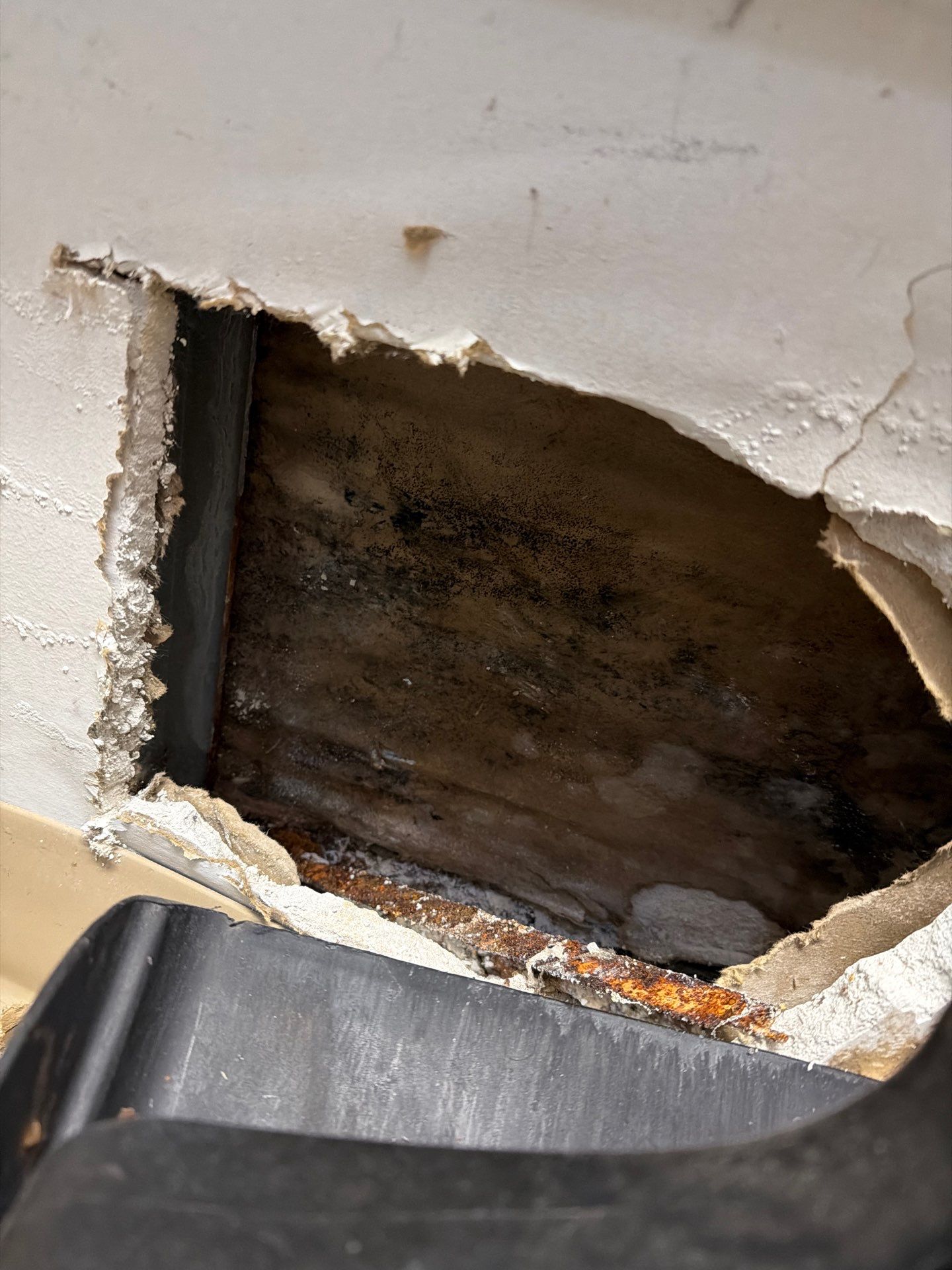
10 Hidden Leak Signs Every Glen Oaks Commons Homeowner Should Know
Walk through your home with this list. If you check more than two boxes, you likely have an active leak.
- Musty smell in one specific room. Mold inside a wall cavity puts off a distinct earthy odor before you see anything.
- Paint bubbling, blistering, or peeling. Moisture pushes from behind the drywall outward.
- Yellow or brown staining. Tannins from wet wood and drywall paper bleed through paint within 48 to 72 hours.
- Warped or spongy drywall. Press gently. If it gives, the gypsum core is saturated.
- Warm or cold spots on a wall. Hot water lines or chilled supply lines leaking inside the cavity change surface temperature.
- Unexplained spike in your water bill. A pinhole leak can waste 100+ gallons a day without ever surfacing.
- Sound of running water when no fixtures are on. Stand still in a quiet house and listen near walls and floors.
- Baseboard separation or buckling. Wet bottom plates swell and push trim away from the wall.
- Floor stains spreading from a wall. Water travels down studs, across the sill plate, and out under the baseboard.
- Visible mold at outlets or vents. Black or green growth at any wall penetration means the cavity behind it is wet.
Where Hidden Leaks Hide in Glen Oaks Commons Homes
Older neighborhoods and newer builds each have their own usual suspects. Most failures cluster around the same locations.
- Shower valves and tub overflow drains, especially in second-story bathrooms
- Toilet supply lines and wax rings on upstairs toilets
- Ice maker lines running through the wall behind the refrigerator
- Washing machine hoses and standpipes in main-floor laundry rooms
- Dishwasher supply lines under kitchen cabinetry
- HVAC condensate lines inside interior walls
- Roof flashing and chimney leaks tracking down rafters into wall cavities
- Frozen pipe splits behind exterior walls after a hard Indiana freeze
Age of the home matters too. Each era brings its own weak points that Glen Oaks Commons Water Restoration technicians see repeatedly on Glen Oaks Commons service calls.
- Pre-1970 homes: Galvanized steel supply lines corroded from the inside out, cast iron drains cracking at hub joints, and original lead toilet flanges shifting over decades
- 1970s and 1980s builds: Polybutylene piping (gray plastic) that fails at fittings, copper pinholes from acidic water, and aging shower pan liners
- 1990s through 2010s: Brass fittings on PEX manifolds, washing machine rubber hoses past their 5-year life, and original builder-grade angle stops with plastic internals
- Newer construction: Improperly crimped PEX connections, settling cracks at drain stacks, and condensate overflow on high-efficiency HVAC units
If your problem started after a cold snap, our frozen pipe burst repair guide walks through the specific damage pattern winter leaks leave behind.
Realistic Cost Ranges for Glen Oaks Commons Hidden Leak Repair
Pricing depends on how long the leak ran, how much material is wet, and whether mold has started. Typical Glen Oaks Commons ranges:
- Leak detection visit with thermal imaging: 250 to 600 dollars
- Single-wall drywall removal and structural drying: 800 to 2,500 dollars
- Multi-room water mitigation with equipment for 3 to 5 days: 2,500 to 6,000 dollars
- Mold remediation inside wall cavities: 1,500 to 6,000 dollars per affected area
- Plumber repair of the actual leak source: 200 to 1,500 dollars depending on access
- Drywall, paint, and trim reconstruction: 1,000 to 4,000 dollars per room
Most homeowner policies cover sudden and accidental leaks. Long-term seepage is usually excluded, which is exactly why catching a hidden leak early matters financially. Our water damage restoration team documents every claim with moisture logs, photos, and IICRC-aligned drying records so adjusters approve faster.
Prevention Steps That Pay for Themselves
Most hidden leaks are predictable. A small investment in monitoring and maintenance beats a five-figure restoration bill every time.
- Install a smart leak detector under every sink, behind the washer, and near the water heater (50 to 150 dollars each)
- Add an automatic shutoff valve on the main supply line that closes when sensors trigger
- Replace rubber washing machine hoses with stainless braided lines every 5 years
- Service your water heater annually and replace it before year 12
- Caulk around tubs, showers, and sinks every 18 to 24 months
- Check toilet supply lines and angle stops twice a year for green corrosion or weeping
- Have a plumber inspect manifolds and pressure regulators if your home is older than 25 years
Detection Tools That Actually Work
You can do some of this yourself before calling anyone. Here is the order we follow on a Glen Oaks Commons service call.
- Moisture meter. Pin-type meters read inside drywall up to 3/4 inch deep. Pinless meters scan up to 1 inch without leaving holes. Hardware store models run 30 to 80 dollars.
- Infrared thermal camera. Wet drywall reads cooler than dry drywall because of evaporation. Phone attachments start around 200 dollars. Professional FLIR units we use run 2,000 to 4,000.
- Borescope or inspection camera. Drill a 3/8 inch hole in an inconspicuous spot, push the camera in, and look directly at the studs and insulation.
- Water meter test. Shut off every fixture in the house, then watch the leak indicator dial on your meter for 15 minutes. If it moves, you have an active supply leak somewhere.
- Dye tablets. Drop in toilet tanks and showers to confirm or rule out specific fixtures as the source.
- Acoustic listening device. Pinpoints pressurized leaks by amplifying the hiss of water escaping a pipe. Useful behind tile or stone where thermal imaging struggles.
A few field tips that save time. Run the thermal camera early in the morning before the sun heats exterior walls, or you will get false readings. Compare moisture meter numbers against a known dry wall in the same room to establish a baseline. And always scan in a grid pattern instead of randomly so you can map the wet area edge to edge.
Red Flags That Mean Call Now, Not Tomorrow
- Visible mold anywhere on or near the wet area
- Water near electrical panels, outlets, or recessed lighting
- Sagging ceiling drywall (collapse risk)
- Sewage odor or any chance the source is a drain line
- Anyone in the home with asthma, allergies, or a compromised immune system
- Leak has been running for more than 48 hours
If any of those apply, stop reading and pick up the phone. Glen Oaks Commons Water Restoration answers around the clock in Glen Oaks Commons, and hidden water does not get better on its own.
What to Do in the First 60 Minutes
Once you confirm a hidden leak, act in this order. Speed matters because IICRC standards consider water clean for only the first 24 to 48 hours before it degrades to Category 2.
- Shut off the water supply to the affected fixture or the main valve to the house
- Turn off electricity to that room at the breaker if water is near outlets or fixtures
- Photograph everything before you move or open anything (insurance will ask)
- Move furniture, rugs, and valuables out of the room
- Place towels or a wet vac at the lowest point where water is collecting
- Call a licensed restoration company for moisture mapping and structural drying
- Notify your insurance carrier and request a claim number
For a full breakdown of timing and pricing on emergency response, see our water damage restoration cost and 24/7 emergency service overview.